
Anti-Restoration Movement
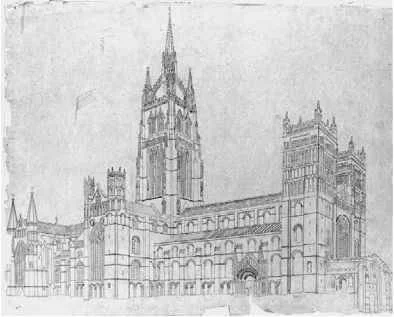
In February 1877 Sir George Gilbert Scott rewrote and enlarged the various accounts of his restorations in his fourth Recollections notebook. As this was after he had decided that the Recollections should be published, the intention was, possibly, to show his critics how much care went into his restoration work. In some places he disclaims responsibility for the mistakes. At Ripon an ‘over zealous clerk of works introduced too much new Stone’ and at Exeter, Clayton had ‘weakly departed’ from Scott’s proposals for decorating the side chapels. But at St Albans he confessed to getting into a muddle over doorways in the aisles of the presbytery and at Hereford he made a mistake in confining the choir to the eastern arm. At Worcester, it was the division of responsibilities between himself and Perkins that led to several problems. But he makes no apologies for his more radical undertakings. Although his Chichester tower purports to be an exact replica of the old, he calmly added ‘5 or 6 feet to its height so that [it] rises above the surrounding roofs’. At St David’s it was the sensible thing to do, apparently, to take down the fifteenth or sixteenth century side walling of Bishop Vaughan’s chapel ‘for the treasure buried in it & having secured that treasure rebuilt [sic] it’. When he comes to the amazing spire-like attachment to the south-east corner of Chester, he is defiant. The old chapel was ‘horribly decayed [that] it spoiled that side of the beautiful Lady Chapel’ but it is difficult to understand how he thought that his own fantastic concoction would provide a better setting for the chapel.
The tone of the eighteen accounts of his cathedral restorations shows that Sir George Gilbert Scott was generally satisfied with his work. He was, after all, the most sought-after restorer of his day. He made frail old structures sound and appropriate for modern worship and could not understand why there was this rising tide of criticism of his methods. St Albans seems to have been a particular worry. Here he was ‘obliged to face right & left to combat two enemies from either hand the one wanting me to do too much & the other finding fault with me doing anything’. It was, of course, Grimthorpe who wanted him to do ‘too much’ and William Loftie who wanted him to do as little as possible.
Sir George Gilbert Scott describes William Loftie as the leader of a ‘narrow party’ in 1877 and it is significant that in 1879, George Gilbert junior omitted ‘narrow’ from the published text. In the two intervening years, what Scott had considered to be a small affair had grown into a huge movement against the restoration methods that he and his generation of architects had employed. This was largely due to the efforts of William Morris. On 3 March 1877, the launch of the national appeal to complete the work on Tewkesbury Abbey was held at Lambeth Palace. Two days later Morris wrote off a furious letter which was published on the 10 March in The Athenaeum. This was a somewhat radical literary and artistic journal edited by the notorious Liberal M. P., Sir Charles Wentworth Dilke, with Frederick George Stephens, who was an early member of the pre-Raphaelites as its art critic. In 1931 it became The New Statesman. This was the sort of paper that Scott avoided reading. However, Lechmere sent him a copy and when thanking Lechmere he wrote:
I have been told that I am systematically and very bitterly traduced by writers in that paper; but as I know that I do not deserve it, I never seek to see these articles, much less to answer them.
The letter that Scott saw in The Athenaeum opens with Morris saying:
My eye just now caught the word ‘restoration’ in the morning paper, and, on looking closer, I saw that this time it is nothing less than the Minister of Tewkesbury that is to be destroyed by Sir Gilbert Scott. Is it altogether too late to do something to save it, – it and whatever else of beautiful and historical is still left us on the sites of the ancient buildings we were once so famous for?
Morris then proposed that an association should be immediately set up:
to keep a watch on old monuments, to protest against all ‘restoration’ that means more than keeping out wind and weather, and, … to awaken a feeling that our ancient buildings are not mere ecclesiastical toys, but sacred monuments of the nation’s growth and hope.
Only ten days later, on 22 March, a meeting was held at Morris’s workshops at 26, Queen Square. There were ten present including Philip Webb and Stephens, and they decided to set up ‘The Society for the Protection of Ancient Buildings’ with Morris as its Honorary Secretary. By March 1879, its membership had grown considerably to include such luminaries as Ruskin and Carlyle, along with E. R. Robson, J. J. Stevenson, Loftie and Sidney Colvin.
What in February 1877 had seemed to Scott to be a routine reaction to his work, two months later had developed into a torrent of criticism against the form of restoration that he had been carrying out for thirty-six years. He had championed conservation in the Plea, read a paper to the Institute, drawn-up directions to builders and Clerks of Works and advocated conservative restoration in all three of his Presidential addresses at the Institute.
It is therefore rather hard to bear that I should now be made the butt of an extreme party who wish to make me out to be the ring-leader of destructiveness.
It was through the Institute that Scott largely proclaimed the correctness of his approach, so it must have been galling that it was there that he received his most hurtful attack, particularly as that attack came from one of his former pupils, J. J. Stevenson.
After 1866, when Stevenson was involved in ‘Greek’ Thomson’s assault against Scott over the Glasgow University commission, he had inherited a fortune, dissolved his Glasgow partnership and ‘spent two leisurely years writing and holidaying in Paris and Broadstairs’. In 1870 he settled in London and built his own house, the Red House on Bayswater Hill, which became the prototype Queen Anne town house. He was now in the fore-front of the Queen Anne Movement with other well-heeled alumni of Scott’s, such as Bodley, Garner and Jackson. He entered into partnership with E. R. Robson in 1871. Robson had been a member of the Institute since 1860 and had probably invited Stevenson to Conduit Street to give a paper although Stevenson did not become a member until the year after Scott’s death.
On 28 May 1877, with the President, Charles Barry, in the chair, Stevenson delivered his bombshell. It was entitled ‘Architectural Restoration: its principles and practice’. In it he cites Scott’s ‘admirable address on the evils of restoration’, read to the Institute in 1862 and then said:
It is difficult after reading his address to believe that any more old churches would be destroyed by restoration. Yet the process has been going steadily on, approved by clergy and architects, the press and the public.
However a paper published by the Institute in 1865, as a result of Scott’s address, he says, ‘seems to me to consist largely of recommendations for their destruction’. This was a short pamphlet entitled Conservation of Ancient Monument and Remains – General Advice to the Promoters of the Restoration of Ancient Buildings, which Scott as a member of the sub-committee of the Institute drew up as a directive for builders and Clerks of Works. In spite of Stevenson’s criticisms it was re-issued in 1888 in a revised and enlarged form.
Stevenson bewailed the fact that in the last thirty years so many old churches have lost valuable features, particularly those installed since the Reformation. He partly blamed the muddled nature of the Advice, as he called the pamphlet, where one paragraph said ‘a vigilant guard should be kept … against the theory that a restored church must be purged of all features subsequent to some favourite period’, while another stated that ‘one main object should be to get rid of modern additions put up without regard to architectural propriety’. He then spitefully said that he assumed that Sir Gilbert Scott had applied the word ‘modern’ in the case of the screen at Canterbury Cathedral to include work from the period of Charles II ‘or probably even of Edward VI’. Stevenson had probably seen Scott’s report of March 1875 in The Archaeological Journal, where he hoped that the fourteenth century screens would be faithfully restored from existing evidence ‘untampered with by modern ideas or prepossessions!’ But two days before he delivered his paper, Stevenson had gone to Canterbury and although the work had been approved by the church authorities, he must have been somewhat dismayed to find that nothing of Scott’s was to be seen.
Scott was, so Stevenson claimed, excluding churches from Ruskin’s advice that old buildings should be carefully preserved and he was encouraging clergy ‘to restore their churches from motives of religion’. He then quoted Ruskin’s famous passage from ‘The Lamp of Memory’ in The Seven Lamps of Architecture:
Take proper care of your monuments, and you will not need to restore them … Watch an old building with anxious care; guard it as best you may, and at any cost, from the influence of dilapidation. Count its stones as you would the jewels of a crown; set watches about it as if at the gates of a besieged city; bind it together with iron where it loosens; stay it with timber where it declines; do not care about the unsightliness of the aid; better a crutch than a lost limb; and do this tenderly, and reverently, and continually, and many a generation will still be born and pass away beneath its shadow.
Scott had used this passage as the basis of an additional note to the Plea in 1850, and again in his address of 1862, but Stevenson was now resurrecting it to attack Scott. However it was not only Scott who was under fire: Street was criticised as were Waterhouse, Butterfield and even Bodley. Modern medieval restorers have filled old buildings with those:
dreary ranges of long benches covered with sticky-looking varnish, the Minton tile pavements, the new stained glass, harsh gaudy purple or dull and colourless, or the gimcrack brasswork in screens and gas-brackets, with their vulgar blue paint, from the eminent firm of Skidmore.
Stevenson’s paper was a long, wide-ranging and somewhat repetitive attack, but in his closing remarks he made it clear whom he felt were the main culprits. It is ‘the knowledge and skill of the architect which destroys the authenticity of the building as a record of the past. He is by profession a clever forger of old documents’. The impact of the paper was immediate. Beresford Hope sprang to the defence of his adopted profession. This was an onslaught on the whole idea that he had been advocating for so many years, of giving churches a spiritual atmosphere. Perhaps Stevenson, with his non-conformist training, regarded church buildings in a different light to the High Church Hope. He accused Stevenson of preaching ‘the gospel of despair and death’ by wanting ‘to keep these poor mutilated buildings in their actual condition of patchwork rottenness’. He finished with this rousing peroration:
Sir, I protest, in the name of this Institute, and in the name of the party which has laboriously year after year, been working for conservative, and every year more and more conservative, and at the same time more eclectic and more liberal principles of restoration, against the attempt to include them in one epigrammatic, inconsistent indictment, ejaculated in the name of a principle which, if carried out, can only be the stagnation of art and a dropping of a curtain between the history of the past and of the present and future: or, in other words, of the glorification of intellectual barbarism.
Ferrey hoped that the discussion would not end that evening and, backed by the President, called on Scott to reply. Poor Scott, apparently, was quite taken aback. He said that he thought he had been dealt with rather tenderly and could hardly complain as ‘I do not think anybody has abused others for spoiling churches as I have done’. Stevenson had the advantage of knowing ‘nothing of the troubles and fightings, and turmoils which we have to do with in restoring churches … he has done nothing, either good or bad, of the kind himself. But my own position is exactly the reverse of this!’ He then defended his proposals for Canterbury and his work at Chester and St Albans which Stevenson had also attacked. He felt that he and Stevenson were ‘in the same boat’ except that ‘he exaggerates the views I have taken, and exaggerates them to such an extent as to render them certainly impracticable, and I think I may venture to say, absurd.’ The meeting then adjourned and, as Ferrey had suggested, it was decided to continue the discussion at the next Ordinary Meeting of the Institute on Monday 11 June 1877.
In the intervening fortnight Scott had had time to gather his thoughts and was not satisfied with what he had said ‘on the spur of the moment’. Typically, he had not appreciated the personal nature of Stevenson’s attack on him and he had now written down a lengthy reply. His tone was conciliatory and although ‘there has been every possible provocation to the line’ taken by the new Society, as far as Stevenson’s paper was concerned:
if purged from certain excesses and over-statements, I will at once say that a very large number of the sentiments and remarks contained in it are simply reiterations of those which I have, for not less than thirty-six years, expressed.
As early as 1841, he says, he was writing to Petit against ‘the modern system of radical restoration’. Then in 1848 came the Plea, in 1863 his paper to the Institute, and in 1873, 1874 and 1875 his three Presidential addresses contained extensive passages on restorations. The Advice, which Stevenson ‘held up to ridicule and reprobation’, was the result of ‘contributions from different members of a sub-committee, which will account for some trifling inconsistencies’. He did agree, however, that the first paragraph was wrong to say that modern work concealing ancient work could be cleared away by the employers rather than their architects and that plaster should not be stripped off to show the junction between parts of different dates. He said that these corrections should be made ‘at once’ but his did not happen until 1888 with the revised pamphlet. Scott went on to list failures due to what he called the ‘do nothing’ system. His paper then became a series of reminiscences about his own restorations. At St John’s, Leeds, with Norman Shaw carrying out the work, they saved this Jacobean church and its fittings. No doubt he wanted to remind his critics of his regard for Jacobean work, as well as his friendship with the rising star of the time. The ‘do nothing’ system resulted in the collapse of Buckingham church tower which led him onto a long description of Hillesden, ‘a church dearly loved by me’. He concluded by wishing the Society success ‘in all their reasonable endeavours’ and warned it against trying to persuade people that it is wrong to restore churches from motives of religion.
Scott’s two former assistants, Street and William White, loyally supported him but Gambier Parry declined to speak ‘on account of the lateness of the hour’. Ewan Christian said that he thought the restoration of Chester was ‘to my mind, a perfect success’. In reply Stevenson explained. ‘It was from no lack of reverence that I used Sir Gilbert Scott’s name; my quarrel is with the system’. But he still mentioned that chapel at Chester and the replacement of the east window at Oxford with a ‘Norman East End’. At the end of the debate, neither party could claim victory. Both sides believed that their approach was correct so inevitably the argument continued although the issue was diminishing as the number of church restorations was slowing down.
On the day following his paper to the Institute, Scott was summoned to appear before the Select Committee of the House of Commons examining methods of rehousing the government offices in the Whitehall area. Hope was Scott’s principal interrogator and his gentle questioning perhaps reflects a desire not to inflict any more pain on the already embattled Scott.
In the same month, June 1877, Loftie published an article in Macmillan’s Magazine entitled ‘Thorough Restoration’. Scott stated that he found Loftie ‘irrepressible for no matter how often a statement of his is refuted he re-iterates it just as if no such refutation had been made’. Loftie’s article was much more of an outright attack on Scott than Stevenson’s paper and Scott promptly replied with a long article entitles ‘Thorough Anti-Restoration’ in the next Macmillan. Loftie had criticised Scott’s work at St Alban’s on both St Michael’s Church and the Abbey. Scott was so incensed with Loftie’s comments on the Abbey that he persuaded Walter Lawrence, the Rector, and Ridgway Lloyd, the authority on St Alban’s shrine, to write in support of his restoration.
Loftie also attacked Scott’s proposals for Canterbury, which he had probably seen in The Archaeological Journal of 1875. He had already criticised them in The Times and, after the failure of the Society’s Tewkesbury attack, brought Scott’s proposals to the attention of William Morris as ripe for condemnation. Morris then fired off another of his famous combative letters on 4 June to The Times but again he had chosen the wrong subject at the wrong time. Scott in Macmillan shows up Loftie’s ignorance about Canterbury but is conciliatory towards the Society. He concludes his article with the following statement:
While I heartily sympathize with the new movement for the preservation of ancient monuments in its leading aims, I must protest against its being carried to the length of leaving our ancient buildings to fall into ruin, or to retain (in all cases) the effects of mutilation, disfigurement, and decay. And, as quite a secondary objection, I would venture respectfully to suggest that the legitimate aims of the movement are hardly likely to be furthered by overstatement or misrepresentation.
But there was still no peace for Scott. Sidney Colvin joined the attack with ‘Restoration and Anti-Restoration’ in the October number of the recently launched The Nineteenth Century. Since Colvin’s criticism of the Albert Memorial in The Pall Mall Gazette in 1872, he had been appointed the Slade Professor of Fine Art and Director of the Fitzwilliam Museum at Cambridge. Scott seems to have regarded Loftie as a light-weight but Colvin was a more formidable opponent and on 19 November 1877 he wrote a considered reaction to Colvin’s criticism, entitled ‘Anti Restoration’ in his Recollections notebook. Surely Colvin could understand the difference between a building which had been restored ‘with the most anxious and studious care – and one ignorantly dealt with without investigation without anxiety without knowledge’, and he widens his counter-attack to include Grimthorpe who ‘puts himself out of the pale by boasting that he is “no Antiquarian”, & by condemning persons who are so’. He concluded with a reproduction of Freeman’s pamphlet, The Preservation and Restoration of Ancient Monuments, published in 1852. He had heard it all before and he knew he was right.